


- Paul VI, homily for the canonization of Charbel Makhlouf, October 9, 1977 (French original)
- Paul VI, address for the beatification of Charbel Makhlouf, December 5, 1965
- Pope Leo XIV, visit and prayer at the tomb of Saint Charbel, Annaya, December 1, 2025
- Dicastery for the Causes of Saints, entry for the 1977 canonization
- Guita G. Hourani, "Saint Sharbel: The Passage to Sainthood," Maronite Research Institute (MARI), 1998 - cites the monastery's death record, the hermit rules, the letters received and the tomb openings
- Santi e Beati, "San Charbel (Giuseppe) Makhluf"
- Vatican State, Saint of the Day, July 24: Saint Charbel Makhlouf
- Fr. Mansour Awad, "Three Lights from the East" (1952), excerpts on charbel.org
- Wikipedia, Charbel Makhlouf (used only to cross-check dates)
- Wikipedia, Mount Lebanon Mutasarrifate (political context: 1860 conflict, 1861 reorganization)
The Life of Saint Charbel Makhlouf
Saint Charbel Makhlouf (1828-1898) was a Lebanese Maronite monk and priest. Born Youssef in Bekaa Kafra, he entered the Lebanese Maronite Order at 23, lived 23 years as a hermit at Annaya from 1875, and died on Christmas Eve 1898. Paul VI beatified him in 1965 and canonized him on October 9, 1977.
Saint Charbel: key facts and guides offers a quick starting point alongside this full history.
Part of the Saint Charbel Encyclopedia. Browse every topic, from his tomb to his novena.
Quick facts
| Born | Youssef Antoun Makhlouf, 1828, Bekaa Kafra, Mount Lebanon. May 8 is the traditional date (see A note on dates) |
|---|---|
| Entered the monastery | 1851, age 23 (Monastery of Our Lady of Mayfouq) |
| Monastic vows | November 1, 1853 (Monastery of Saint Maron, Annaya) |
| Ordained priest | 1859, at Bkerke |
| Hermit | 1875 to 1898, Hermitage of Saints Peter and Paul, above Annaya |
| Died | December 24, 1898 |
| Beatified | December 5, 1965 (Paul VI, St. Peter's, three days before the close of Vatican II) |
| Canonized | October 9, 1977 (Paul VI, St. Peter's) |
| Feast | July 24 (Roman calendar, optional memorial). Third Sunday of July (Maronite calendar). December 24 is the anniversary of his death |
| Tomb | Monastery of Saint Maron, Annaya, Jbeil district |
| Order | Lebanese Maronite Order |
In one minute
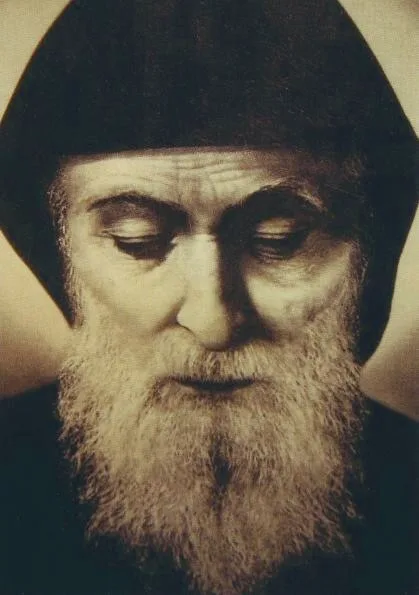
He wrote nothing that survives. He held no office and founded nothing, and he spent the last 23 years of his life in a stone hermitage above a mountain monastery. The Church did not honor him for a program. It honored a life lived inside three vows (poverty, chastity and obedience), a daily Mass and silence.
Paul VI said so directly in 1977, in the canonization homily: the life is hard, and the key to it is the search for conformity to the humble and poor Christ, with the Mass at the center.
1. The world he was born into (1828-1851)
Charbel was born under Ottoman governors and Lebanese emirs. Mount Lebanon was a mountain society of villages, terraced fields, silk weaving and monasteries, ruled at a distance, with taxes to pay and forced labor service called corvée. Bekaa Kafra, his village, is one of the highest villages in Lebanon, on the edge of the Qadisha Valley, where Christian hermits had lived for centuries.
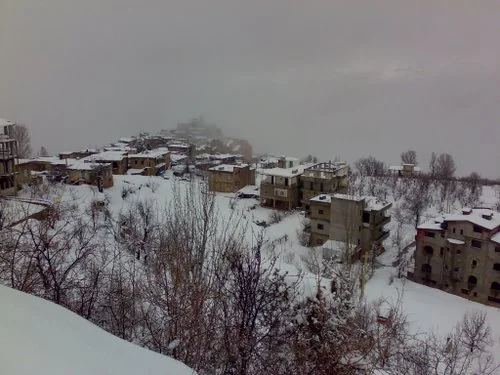
He was baptized Youssef, the youngest of five children of Antoun Zaarour Makhlouf and Brigitta Chidiac. According to the traditional biographies, his father, a mule driver, was pressed into corvée service and died in 1831 on the way home, when Youssef was three. His mother later married Lahoud Ibrahim, who became a priest under the name Abdel-Ahad. The Maronite tradition allows married men to be ordained. Youssef grew up serving Mass for his stepfather.
He went to the village school, learned Arabic and Syriac, and from about age ten looked after the family's animals. Tradition says he prayed in a grotto near the pastures, which villagers later called the Saint's Grotto. Two of his mother's brothers were hermits at Qozhaya in the Qadisha Valley. He visited them, and their example set what he wanted. His mother and his uncle Tanios, his guardian, were against it, and his mother wanted him to marry.
At 23, in 1851, he left without telling anyone and walked to the Monastery of Our Lady of Mayfouq. In the 1977 homily Paul VI recorded the words attributed to his mother after he left: "If you were not to be a good religious, I would tell you to come home. But now I know the Lord wants you in his service. In my grief at being parted from you, I say, resigned: May he bless you, my child, and make you a saint." (our translation from the French). He never went back to his village.
Charbel's Lebanon, 1828-1898
Charbel lived through a hard century for Mount Lebanon. Ottoman governors and local emirs ruled a population of mostly Maronite and Druze villagers. Forced labor, heavy taxes and rivalry between families and communities were part of daily life. In 1860 the conflict between Maronites and Druze turned into a civil war that spread to Damascus and the Beqaa. In 1861 the Ottoman state, under pressure from European powers, set up the Mount Lebanon Mutasarrifate, a Christian-governed region. Charbel entered the monastery before these events and was a hermit during the years of the new arrangement.
Inside that world the Lebanese Maronite Order was a stable institution. It was united under one Rule in 1695 and, according to the Maronite Research Institute (MARI), had over 1,000 monks in his time among roughly 300,000 Maronites. A monastery was a farm, a school, a place of prayer and a refuge. That is why a village boy could walk to one and become a priest: it was open to him.
2. The monk (1851-1875)
A new name
As a novice he took the name Charbel, after a martyr of the church of Antioch. The Maronite Church traces its roots to Antioch, so the name was a deliberate sign of belonging.
Vows
His novitiate began at Mayfouq and continued at the Monastery of Saint Maron at Annaya. On November 1, 1853, at Mass, with the superior, novice master and community present, he made his vows of obedience, chastity and poverty until death. Families and the public were not admitted.
Study
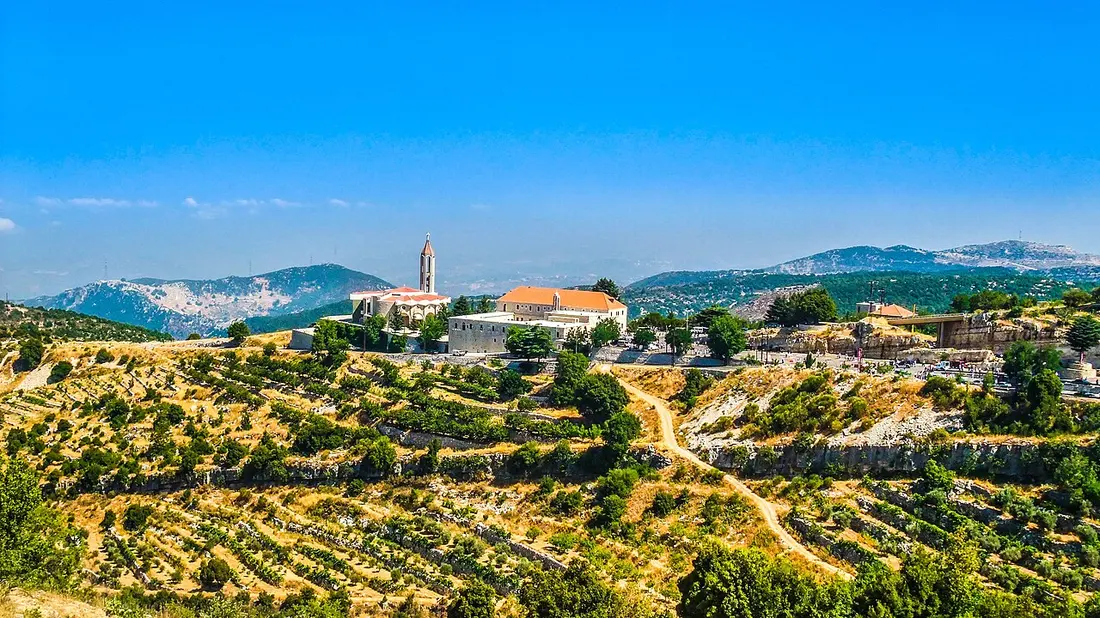
He was then sent to the Monastery of Saints Cyprian and Justina at Kfifan, the Order's main school of theology, for philosophy and theology (about six years, to 1859). One of his teachers there was Nimatullah Kassab Al-Hardini, a reforming monk who became his spiritual guide. Saint Nimatullah was beatified in 1998 and canonized on May 16, 2004, so Charbel reached sainthood first.
Priesthood
He was ordained at Bkerke, the seat of the Maronite Patriarch, in 1859. Sources give only the year with confidence, so we print the year and not the day.
Sixteen ordinary years
After his ordination he lived at Annaya for 16 years as a monk among monks. Paul VI gives this number in the canonization homily, and says that these 16 years of community life were followed by 23 years of complete solitude. Monastic life at that time was ora et labora: he worked the monastery's land and planted and harvested alongside the other monks. No account describes him holding office. What his brothers remembered was how fully he kept the Rule.
3. The hermit (1875-1898)
In 1875, at 47, he received permission to live in the Hermitage of Saints Peter and Paul, a short walk uphill from the monastery (the hermitage). The hermitage had been built as a monastery in 1798 and became a hermitage in 1829, when the Order moved its community to the Monastery of Saint Maron nearby. Earlier hermits there included Alisha Al-Hardini, the brother of Charbel's teacher Nimatullah.
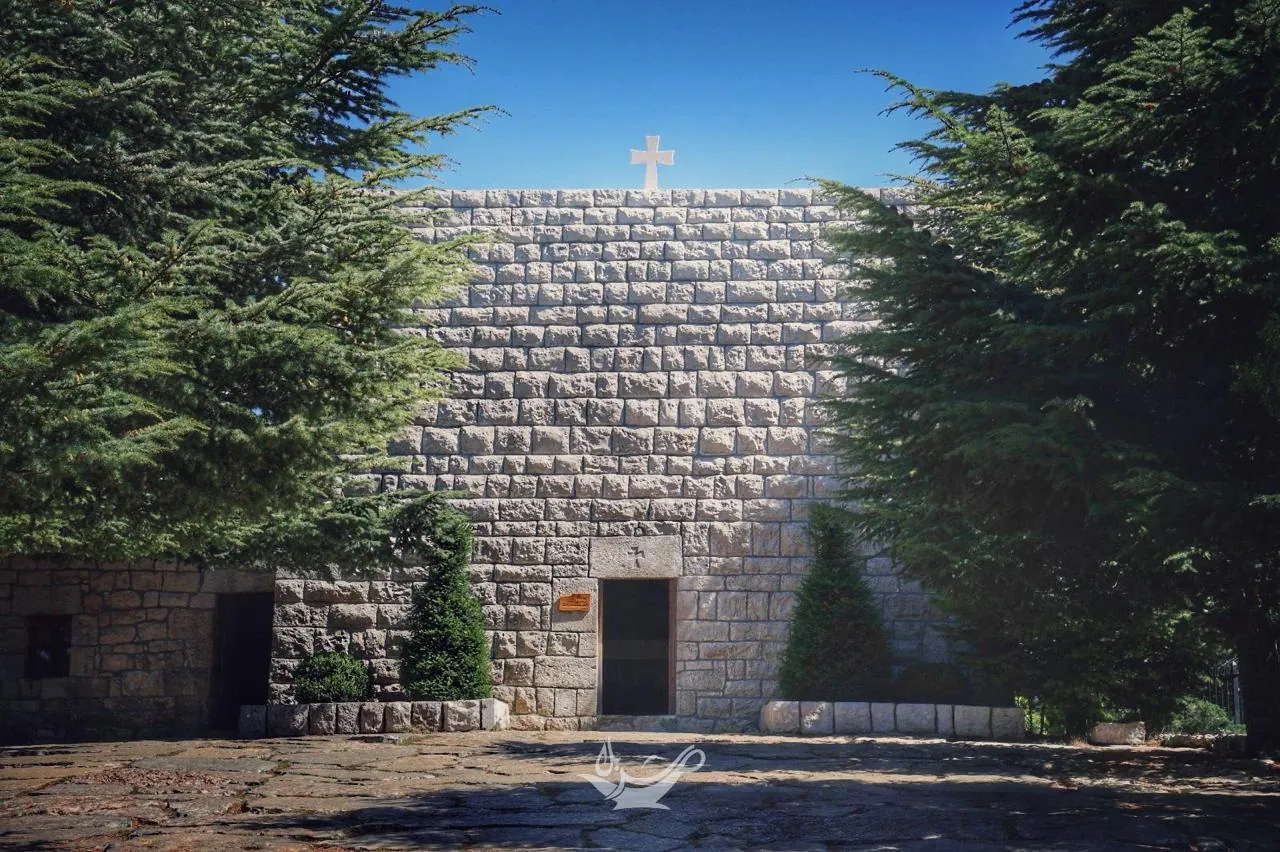
This was not a free-form life. A hermit of the Order lived under written rules. He could not leave without the superior's consent, had to keep silence except when necessary, could not eat meat or drink wine, could sleep no more than five hours, and ate one meal a day, sent from the monastery. The Order's own accounts add what his companions recorded: a hair shirt, a hard bed of goat hair on the floor, a log wrapped in cloth for a pillow, and the leftovers of his companions' meals. Some of the more severe practices are known from those companions' testimony rather than from official documents.
His day ran around the Eucharist: adoration, Mass, then manual work in the small plot, then fasting and prayer. In 1977 Paul VI described the point of it plainly. The austerity was a means. The goal was union with Christ, and he was clear that it was not a path proposed to everyone. He added that such lives remind the whole Church of something no one is excused from.
People came up the hill anyway, according to village memory, for blessings and prayer. Traditional accounts of healings from his lifetime exist. They belong to oral and monastic memory and were not the basis of the Church's judgment.
A day at the hermitage
- Night and early morning: prayer and adoration of the Eucharist.
- Mass, with long thanksgiving afterward.
- Manual work in the small plot.
- One meal, brought from the monastery.
- Little sleep (the rule capped it at five hours).
- Leave the hermitage only with the superior's permission.
This is the rule he lived under, as reported by MARI. Accounts of how far he went beyond it come from his companions and are devotional testimony.
4. December 1898
The stroke
On December 16, 1898, while saying the Divine Liturgy in the hermitage chapel, Charbel was struck down. The Order's accounts say it happened while reciting a liturgical prayer ("Father of truth, behold your Son, a sacrifice pleasing to you...") and that he kept his hands clasped around the Eucharist as he fell. His companion, Father Makarios Al-Mishmeshani, and other monks helped him to his cell. The prayer fragment is an English rendering of the quoted historical account, not an authorized liturgical translation.
Death
Eight days later, on Christmas Eve, he died, saying the names of Jesus, Mary and Joseph.
Burial
His body lay overnight in the hermitage church while the monks kept vigil. On Christmas morning a small procession of monks and villagers from the neighboring villages carried him through snow down to the monastery on a stretcher of three planks. A funeral service was held in the monastery church. The next morning he was buried in the monastery cemetery as every monk of the Order was: with no coffin, in his habit, in a pit that held earlier monks' bones. Water was dripping in. Some asked for a coffin or a private tomb, and the monk in charge refused any exception.
The one authenticated record
According to MARI, the only authenticated document in the monastery archive about his life is the death entry. It was written by the superior, Father Antonios Mishmeshani, who had been away at the Patriarchate and came back to find Charbel dead. He wrote that he would not give details of his life "because of what he is going to accomplish after his death", and that his obedience was "angelic and not human". The entry gives his age as 68. Counting from 1828 gives 70, the figure Paul VI used. We print 70 and note the difference.
5. The tomb (1899 onward)
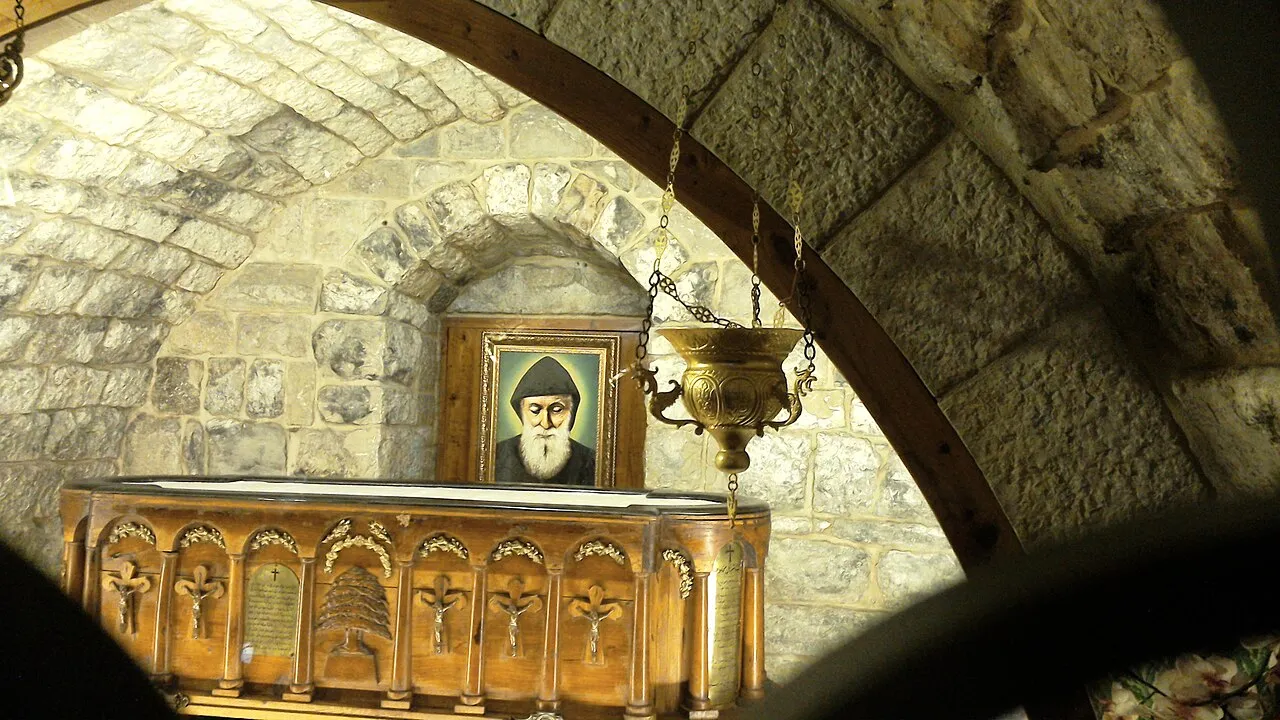
Reported light. Monks and villagers reported a light over the grave after the burial. The Order's accounts say it drew attention, including from an Ottoman patrol, and the superior asked the Church authorities for leave to open the grave. This is reported tradition, and we label it as such.
April 1899. The tomb was opened on April 15, 1899, four months after burial. Witnesses who testified later in the canonical process described a body intact and flexible in a flooded, muddy grave, with a blood-like moisture, which they said continued for decades.
Later examinations. The tomb was opened and the body examined several times in the twentieth century. Santi e Beati (secondary) says that in 1950, after a damp liquid was seen on the tomb wall, the tomb was reopened on February 25 in front of the whole monastic community, and again on April 22 by the religious authorities with a commission of three doctors. MARI reports eight openings between 1950 and 1975 in the presence of doctors and Church representatives, and says the moisture flowed for 67 years from 1899. Other sources, citing the postulator, report that the body was found fully decomposed in 1976. Reports differ, and we say so. We do not make claims about "no medical explanation" in our own voice. Those are the statements of the Order and of witnesses.
What can be said with confidence: pilgrims came from the first weeks, the Church investigated in the decades that followed, and veneration at the tomb was the basis for the cause, together with the healings in the next section. See also the tomb and his relics.
6. From tomb to altar: the cause
The Church does not canonize on the basis of the tomb. In his cause, the Church investigated his life and virtues, and it examined the miracles accepted for his beatification and canonization.
| Cause opened | In the 1920s (sources give different years) |
|---|---|
| Beatification | December 5, 1965 - Paul VI, in St. Peter's, three days before the close of Vatican II |
| Canonization | October 9, 1977 - Paul VI, St. Peter's, with Patriarch Antoine Pierre Khoraiche and a Lebanese government delegation present |
MARI names the two healings accepted for beatification: those of Sister Maria Abel Kamari (Sacred Hearts congregation) and of Iskandar (Alessandro) Obeid, who had lost sight in one eye. According to Santi e Beati (not MARI), a third healing, of a woman named Awad in the 1960s, was accepted for canonization. Secondary sources disagree on the first name, the date and the illness, so we do not give them here.
What Paul VI said in 1965, as translated by MARI: "In a world largely fascinated with riches and comfort, he helps us understand the paramount value of poverty, penance and asceticism to liberate the soul in its ascent to God."
What Paul VI said in 1977 (our translation from the French on vatican.va): Charbel is "a very singular son, a paradoxical artisan of peace, since he sought it away from the world, in God alone." He added that "his lamp, lit at the summit of the mountain of his hermitage in the last century, has shone with ever greater brilliance."
7. After canonization
- The Dicastery for the Causes of Saints describes Charbel Makhlouf as a priest of the Lebanese Maronite Order who withdrew from the monastery to a hermitage in search of austere solitude and came to rest in the Lord on December 24.
- Monastery records cited by MARI say Annaya had received 135,000 letters from 95 countries by 1977.
- On the 22nd of each month pilgrims gather at Annaya for Mass and prayer. A tradition going back to a reported 1993 dream of Nohad El Shami, a woman who said she was healed, says the saint asked her to visit the hermitage on the 22nd. This is a reported private account, not a Church declaration. See the 22nd of the month.
- On December 1, 2025, Pope Leo XIV prayed at the tomb at Annaya and left a lamp as a gift. He said of Charbel: "What is the legacy of this man who wrote nothing, who lived a hidden and silent life, yet whose fame spread throughout the world?"
8. What the Church says, and what is tradition
| Birth, entry to the Order, vows, ordination, hermitage, death | Documented in Church sources (Paul VI's 1977 homily and the Dicastery for the Causes of Saints) |
|---|---|
| Beatification and canonization dates | Vatican records |
| Incorrupt body, blood-like moisture, light over the tomb | Reported in accounts from the Order and from witnesses. The Church's investigation looked at them. The Church did not canonize him on this basis |
| Miracles accepted by the Church | Two for beatification and one for canonization. Secondary sources disagree on the details of the canonization miracle |
| Healings, apparitions, visions, the tradition of the 22nd of the month | Devotional reports, not Church declarations |
Visiting Annaya
Annaya is in the Jbeil district. The drive from Beirut is about 52 kilometers, usually around 90 minutes depending on traffic. The tomb is in the monastery church, and the hermitage is a short walk uphill. The monastery receives visitors daily; check opening times with the monastery before you travel. The 22nd of each month is the busiest day: Leo XIV described "thousands of pilgrims from different countries" coming that day. Plan your visit with Visiting Annaya, see the hermitage, or walk through the Annaya online tour.
Names and spellings
Charbel, Sharbel, Sarbel and Charbelle all appear. The Syriac form is Mar Sharbel, and Mar is the honorific for a saint. Vatican documents have used Makhlouf, Makhluf and Maklūf. In Latin America he is San Charbel. His baptismal name was Youssef (Joseph).
A note on dates
- Birth date. May 8, 1828 is the traditional date. Santi e Beati says it is "probably" May 8 and uncertain. MARI says "around 1828" and notes that no authenticated birth certificate has been found.
- Ordination. 1859. Some sources give July 23, but the Vatican and MARI give only the year.
- Age at death. 70 by calculation and in Paul VI's homily. 68 in the monastery's own death entry.
- Years in community. 16 after ordination, as Paul VI says. The Vatican State's Saint of the Day says 15.
Where to go next
Frequently Asked Questions
Who was Saint Charbel?
A Lebanese Maronite monk and priest (1828-1898) who lived 23 years as a hermit at Annaya. He was canonized by Paul VI in 1977.
When was Saint Charbel born?
Traditionally on May 8, 1828, in Bekaa Kafra. No authenticated birth record gives the exact day.
Where did Saint Charbel live?
He lived at the Monastery of Our Lady of Mayfouq (novitiate), the Monastery of Saint Maron at Annaya (vows, then community life), the Monastery of Saints Cyprian and Justina at Kfifan (studies), and from 1875 to 1898 at the Hermitage of Saints Peter and Paul above Annaya.
How did Saint Charbel die?
He suffered a stroke on December 16, 1898, while celebrating the Divine Liturgy, and died eight days later, on December 24.
When was Saint Charbel canonized?
October 9, 1977, by Paul VI, after his beatification on December 5, 1965.
Did Saint Charbel write anything?
Pope Leo XIV called him a man who wrote nothing, in his prayer at the tomb on December 1, 2025.
Is the body of Saint Charbel really incorrupt?
Accounts from the Order and from witnesses say the body was found intact for decades and that a blood-like moisture flowed from it. Reports differ on what later examinations found. The Church canonized him for his life and for healings it approved, not for the condition of the tomb.
Why did Saint Charbel become a hermit?
After ordination he lived 16 years in community at Annaya. In 1875 his superiors permitted him to live in the hermitage of Saints Peter and Paul, where he lived under written rules until his death.
Why are there two feast days?
July 24 is the date in the Roman calendar, an optional memorial. The Maronite calendar keeps the third Sunday of July. December 24 is the anniversary of his death.