Page 1 of 10
Loading story...
Please wait while we open the storybook.
A true story told in simple words: a girl from Lebanon who chose a life of prayer, taught children, protected a child in danger, and received care from her sisters during years of illness.
Short answer: This read-aloud Saint Rafqa storybook for children ages 5 to 12 tells how Boutroussieh of Himlaya chose a life of prayer, taught children, hid a child under her robe to keep him safe, and bore years of blindness and illness with patience. It closes with the Church remembering her as Lebanon's first canonized woman.
This read-aloud storybook tells children ages 5 to 12 the true story of Saint Rafqa: the girl Boutroussieh from the village of Himlaya who chose a life of prayer, taught children, once hid a child under her robe to keep him safe, and bore years of blindness and illness with patience. It closes with the sisters who cared for her at Jrabta and with the Church remembering her as Lebanon's first canonized woman.
The grown-up account, with sources, her prayers, and her shrine, is on the St Rafqa page.
Page 1 of 10
Please wait while we open the storybook.
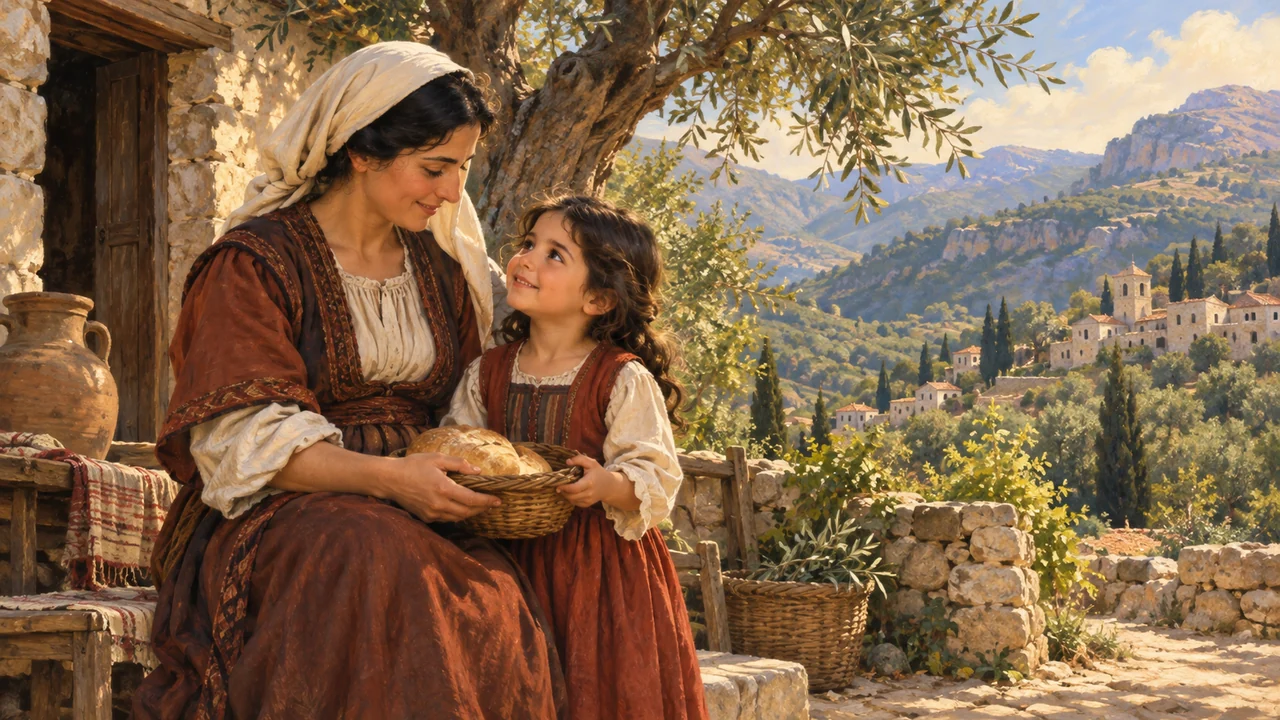
AI-generated read-aloud narration. Illustrations are original composite scenes, not historical footage.
Boutroussieh Choboq el-Rayess was born on June 29, 1832 in Himlaya, Lebanon. Her mother died when she was seven. After years of domestic service she joined a religious congregation, then in 1871 entered the Lebanese Maronite Order, the same order as Saint Charbel, and took the name Rafqa.
In 1885 she prayed to share in the suffering of Christ. Severe illness followed and she lost her sight, then most of the use of her body. Witnesses say she stayed patient and thankful, and she kept knitting with her hands. She died on March 23, 1914 at the monastery of Saint Joseph al-Dahr in Jrabta, where her shrine is today. She was the first woman of Lebanon to be canonized.
Read the full life of Saint Rafqa
Sources: Holy See: biography of Rafqa Choboq.
These scenes are imaginative illustrations, not historical footage. Her experience before the icon and her dream are reported inner experiences. Some kitchen and knitting scenes are composites, not recorded afternoons. Rafqa sought medical care; children should tell a trusted adult when they are hurting. The final narrated page offers four points of reflection.
Sources: Holy See biography, Saint Rafqa Monastery biography, monastery history, and 2001 canonization homily.
A Lebanese nun (1832-1914) of the same Maronite order that formed Saint Charbel, and the first woman of Lebanon to be canonized. Blind and largely paralyzed in her last years, she stayed patient and thankful. Her shrine at Jrabta still draws pilgrims.
Children ages 5 to 12, reading on their own or listening with family. Every page has a Read Aloud button with gentle narration, so the book can be heard as well as read.
Yes. It retells documented events. Her reported inner experiences, like what she felt before the icon and her dream, are named as reported experiences in the book's own notes.
The St Rafqa page on this site tells her full story for adults, with sources, her prayers, and her shrine at Jrabta.