Saint Augustine’s best-known prayers are not formulas written for others to recite. They are passages from his Confessions, a book addressed to God, in which he tells the story of his restless youth and his conversion. They have been prayed as prayers for sixteen centuries. This page gives two of them in a public-domain English translation, unchanged.
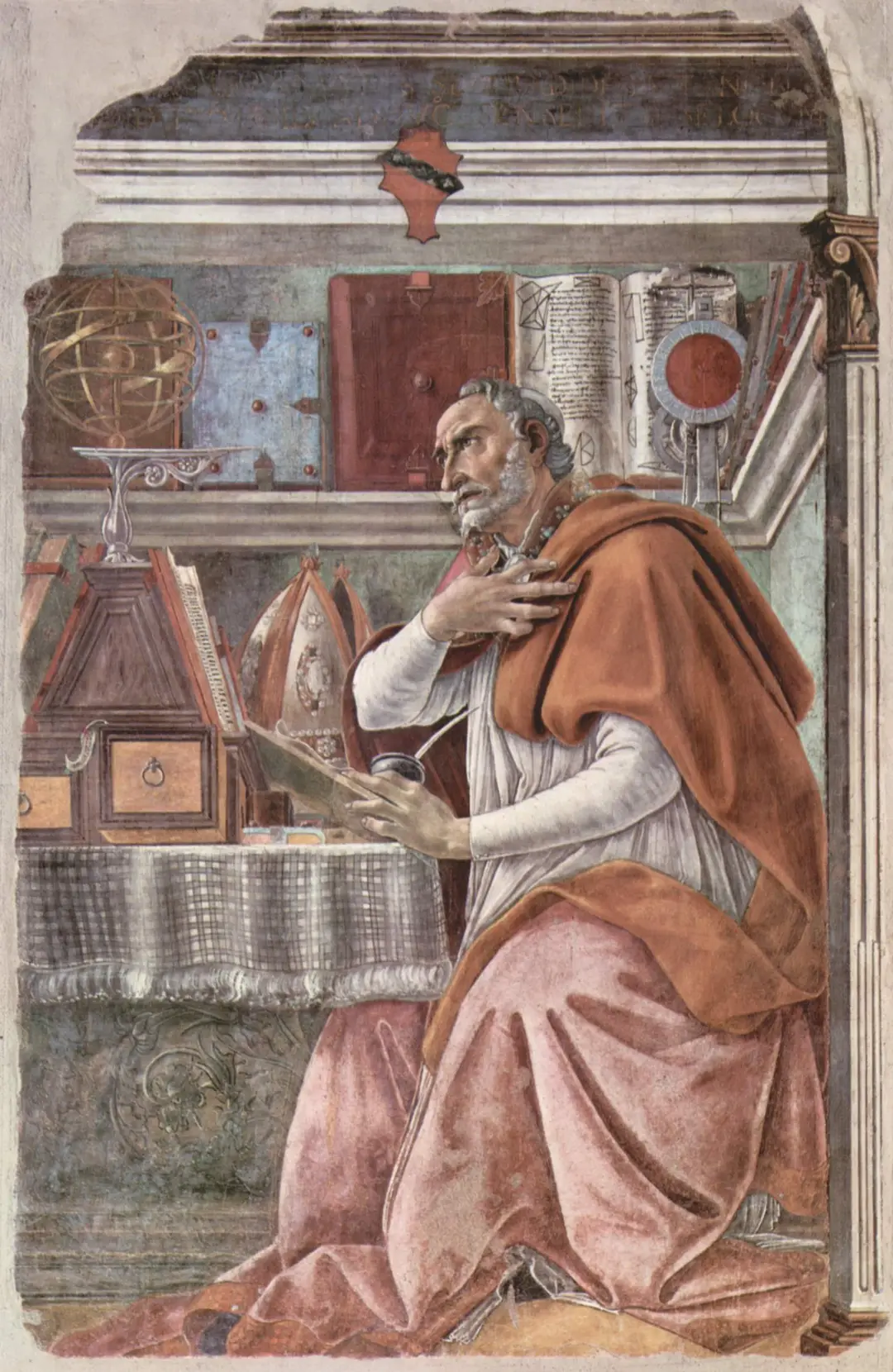
Saint Augustine in his study - Botticelli's 1480 fresco in the church of Ognissanti, Florence. Public domain, via Wikimedia Commons.
The translation is that of Edward Bouverie Pusey (1838), public domain. Where Pusey and a modern translator differ, the sense is the same; his archaic “Thou” is kept as it is printed.
"Our Heart Is Restless"
Great art Thou, O Lord, and greatly to be praised; great is Thy power, and Thy wisdom infinite. And Thee would man praise; man, but a particle of Thy creation; man, that bears about him his mortality, the witness of his sin, the witness that Thou resistest the proud: yet would man praise Thee; he, but a particle of Thy creation. Thou awakest us to delight in Thy praise; for Thou madest us for Thyself, and our heart is restless, until it repose in Thee.
Purpose
Praise and orientation: it names God as the end for which we were made and the reason for our restlessness.
How to pray
Slowly, and stop at the last clause. Let the word “restless” name what is actually unsettled in your life, then give it to God.
When & how long
Morning or evening, or any time of unease. Under a minute.
Source & tradition
Confessions, Book I, chapter 1, opening lines; written by Augustine as Bishop of Hippo, around the years 397 to 400. Prayed from the text itself, in Pusey’s English translation (1838).
Spiritual fruit
A settled reason for the search: the tradition reads it as the Church’s plainest statement that the human heart is made for God. It offers no promise of an outcome.
"Too Late Loved I Thee"
Too late loved I Thee, O Thou Beauty of ancient days, yet ever new! too late I loved Thee! And behold, Thou wert within, and I abroad, and there I searched for Thee; deformed I, plunging amid those fair forms which Thou hadst made. Thou wert with me, but I was not with Thee. Things held me far from Thee, which, unless they were in Thee, were not at all. Thou calledst, and shoutedst, and burstest my deafness. Thou flashedst, shonest, and scatteredst my blindness. Thou breathedst odours, and I drew in breath and panted for Thee. I tasted, and hunger and thirst. Thou touchedst me, and I burned for Thy peace.
Purpose
Conversion and thanksgiving: it is Augustine’s own account of how God found him when he had been looking everywhere else.
How to pray
Take it one sentence at a time, and pause on “Thou wert within, and I abroad.” It is a prayer of confession in the old sense: an honest account, addressed to God.
When & how long
Evening is fitting, or after a failure or a return to prayer. About two minutes.
Source & tradition
Confessions, Book X, chapter 27, in the same translation. Traditional text of the Western Church, widely prayed and quoted.
Spiritual fruit
Honest repentance and gratitude: the passage ends in peace, with God as the one who called first. It is a reflection on grace, not a formula.
How to Pray with Saint Augustine
1. Pray it as his story
Both prayers come out of a particular life: years of searching, a divided will, and a late conversion. Read a little about it first, and pray in the same honesty.
2. Keep the second person
Augustine speaks to God, not about Him. Say “Thou” or “You” aloud, the way he does.
3. Pair them
“Our heart is restless” in the morning, “Too late loved I Thee” in the evening, is a simple daily pattern.
4. Use it in a hard season
He wrote these after years of struggle. They are for people who feel they came to faith, or came back, late.
Frequently Asked Questions
What is the most famous prayer of Saint Augustine?
“Thou madest us for Thyself, and our heart is restless, until it repose in Thee,” from the first chapter of the Confessions.
Is "Late have I loved you" a real prayer?
Yes. It is from Book X of the Confessions, and it has been prayed on its own for centuries. Different translators render it as “Late have I loved You” or “Too late loved I Thee.”
Did he write prayers for others to recite?
His prayers in the Confessions are addressed to God in the first person, as part of his own story. The Church has taken them up as prayers. Many “Prayers of Saint Augustine” online are of uncertain origin, so this page uses only the text of the book.
Which translation is this?
Edward Bouverie Pusey’s English translation of 1838, in the public domain, read from the Project Gutenberg edition.