Prayers of the Saints - Feast September 13

The Prayer of St. John Chrysostom

Saint John Chrysostom, the “golden-mouthed” preacher of Antioch and Constantinople, left no single prayer that every historian can trace to his own pen. The prayer that carries his name is one the Church has said for well over a thousand years in the liturgy that bears it. This page gives it in its classic English form, with an honest note on what is and is not known of its origin.

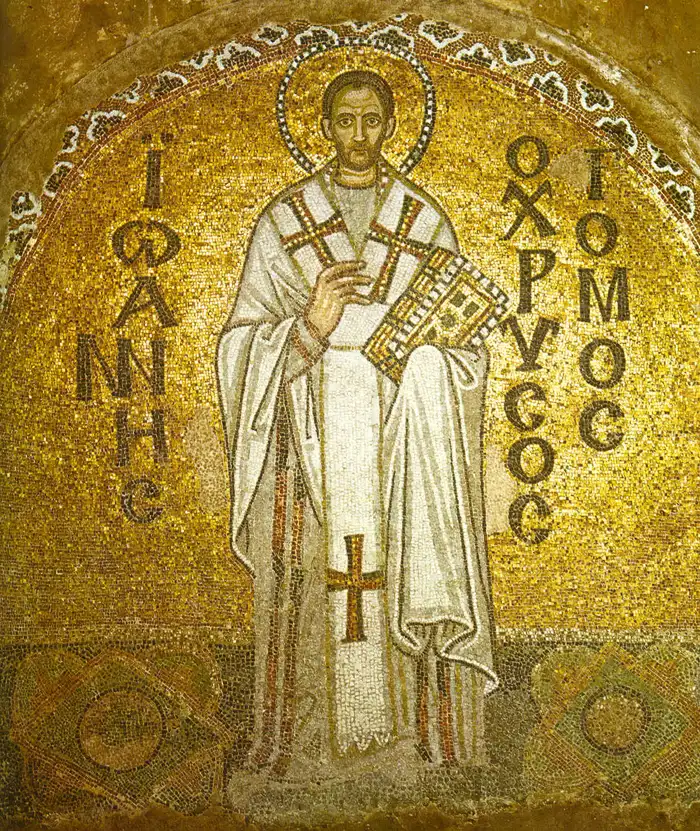
Gold mosaic of Saint John Chrysostom with a Greek inscription, Hagia Sophia
The gold mosaic of Saint John Chrysostom in Hagia Sophia, Istanbul, with his name in Greek. Public domain, via Wikimedia Commons.

A Prayer of Saint Chrysostom

The English is Thomas Cranmer’s rendering of 1544, long used in the Book of Common Prayer and in the public domain. The words are given as printed, with nothing added.

Almighty God, Who Hast Given Us Grace

Almighty God, who hast given us grace at this time with one accord to make our common supplications unto thee; and dost promise that when two or three are gathered together in thy Name thou wilt grant their requests: Fulfil now, O Lord, the desires and petitions of thy servants, as may be most expedient for them; granting us in this world knowledge of thy truth, and in the world to come life everlasting. Amen.

Purpose
A closing prayer for a gathered group: it recalls Christ’s promise to those who gather in his name (Matthew 18:20) and asks that their petitions be answered as is best for them.
How to pray
Aloud with others if you can, a family at table or a group before it disperses. Pause on “as may be most expedient for them”: the prayer asks for what is good, not for every request as worded.
When & how long
At the end of a shared prayer, a meeting, or a family prayer time. About thirty seconds.
Source & tradition
A short prayer from the Greek Byzantine liturgy, said before the third antiphon. It is traditionally called the Prayer of Saint Chrysostom, but the Church historian Philip Schaff notes its precise origin is uncertain: it is not in the oldest manuscripts of Chrysostom’s Liturgy, but in those of the Liturgy of Saint Basil. Thomas Cranmer put it into English in 1544 for the Litany of the English Church. Traditional; its link to Saint John Chrysostom is by long tradition, not proven authorship.
Spiritual fruit
Confidence in prayer made together, with humility about the outcome. The prayer promises knowledge of God’s truth and eternal life, not that every request will be granted as asked.

How to Pray with Saint John Chrysostom

1. Pray it together

The prayer is written in the plural: “our common supplications.” It is made for two or three praying at once, and it is at its best that way.

2. Keep it short

It closes a longer prayer. Say your intentions first, then this.

3. Mean the condition

“As may be most expedient for them” is the heart of the prayer. Ask for what you need, and leave the form of the answer to God.

4. Pair it with his preaching

Chrysostom taught that prayer belongs at home as well as church. His homilies return constantly to prayer and family life; his page says more.

Frequently Asked Questions

Did Saint John Chrysostom write this prayer?

Not that anyone can prove. It is named for him because it stands in the Byzantine liturgy that bears his name, but older manuscripts of that liturgy do not have it, and Philip Schaff calls its precise origin uncertain.

Why is it in the Anglican prayer book?

Archbishop Thomas Cranmer translated it from the Greek for the English Litany in 1544, and it was placed at the end of daily Morning and Evening Prayer in 1661. It is a shared inheritance of Eastern and Western Christians.

Is it a Catholic prayer?

It is a Christian prayer from the early Greek liturgy, prayed in the Eastern churches. This page uses the English form that has circulated most widely, and it is not a Roman Missal text.

Does the prayer promise that our requests are granted?

No. It asks that they be fulfilled “as may be most expedient,” meaning as is best. That condition is part of the prayer.

More Prayers

Full Prayer Library

Prayers by need and season from the Catholic and Maronite tradition, each with its source.

Saint Charbel Prayers

The prayers of Lebanon's hermit of Annaya, with the novena and the traditional intercessions.

Saints & Blesseds

Every saint on this site, with their story and where to pray with them.

Sources