The full canonization Mass of April 27, 2014 - Pope Francis declaring John XXIII and John Paul II saints in Saint Peter's Square, from the Vatican's own Vatican News channel (about 3 hours 40 minutes). Watch on YouTube.
St. John Paul II
A quarry worker who became a priest in secret, a Polish cardinal who became the first non-Italian pope in 455 years, and a pilgrim who carried the Gospel to 129 countries. He opened his pontificate with three words the late twentieth century needed - "Do not be afraid" - and he lived them through an assassin's bullet, the fall of a dictatorship, and a long public dying. He is a canonized saint of the universal Church, and this page is his story, his teaching in his own words, and where to watch him.
At a Glance
Who: Karol Józef Wojtyła (1920-2005), Pope John Paul II from 1978 to 2005.
Known for: one of the longest pontificates in history - twenty-six and a half years; the first Polish pope; 129 countries visited; a central figure in the peaceful end of communism in Eastern Europe; the 1981 assassination attempt he survived and forgave.
Status: canonized Saint on April 27, 2014, by Pope Francis, alongside Pope John XXIII. His feast day is October 22, the anniversary of the start of his pontificate.
The miracle for his canonization: the healing of Floribeth Mora Díaz of Costa Rica from an incurable brain aneurysm in 2011, recognized as miraculous through his intercession.
His Life (1920-2005)
Karol Wojtyła was born on May 18, 1920, in Wadowice, a small town in southern Poland. Loss came early: his mother died when he was eight, his only brother when he was twelve, and his father - a retired army officer who prayed on his knees at night - when he was twenty. He studied Polish language and literature at the Jagiellonian University in Kraków until the Nazi occupation closed it in 1939. To avoid deportation he worked as a manual laborer, first in a limestone quarry, then in a chemical plant, and he acted in an underground theater that kept Polish culture alive where words could be weapons.
In 1942, in secret, he entered Kraków's clandestine seminary. He was ordained a priest on November 1, 1946, sent to Rome for a doctorate on the mystical theology of Saint John of the Cross, and came home to parish work among students and young families - kayaking with them, hearing confessions on hikes, teaching that faith had to be argued, not inherited. He became an auxiliary bishop of Kraków in 1958, its archbishop in 1964, a cardinal in 1967, and one of the most active bishops at the Second Vatican Council. On October 16, 1978, at fifty-eight, the conclave elected him pope - the first Pole, and the first non-Italian in 455 years.
His first pilgrimage home, in June 1979, drew millions into the streets of a communist country that had tried for decades to crowd faith out of public life. Historians argue about causes, but few dispute that those nine days helped set in motion the Solidarity movement and, within a decade, the peaceful collapse of the Soviet bloc. On May 13, 1981, a Turkish gunman, Mehmet Ali Ağca, shot him in Saint Peter's Square. He survived, credited his survival to Our Lady of Fatima, and two years later visited his would-be killer in prison and forgave him.
The last years were a different kind of witness. Parkinson's disease bent his frame and weakened the strongest voice in the Church, and he let the world watch. He died on April 2, 2005, and the crowd at his funeral chanted "Santo subito" - a saint, right away. Pope Benedict XVI beatified him on May 1, 2011; Pope Francis canonized him on April 27, 2014, in a joint ceremony with Pope John XXIII.
The Pilgrim Pope
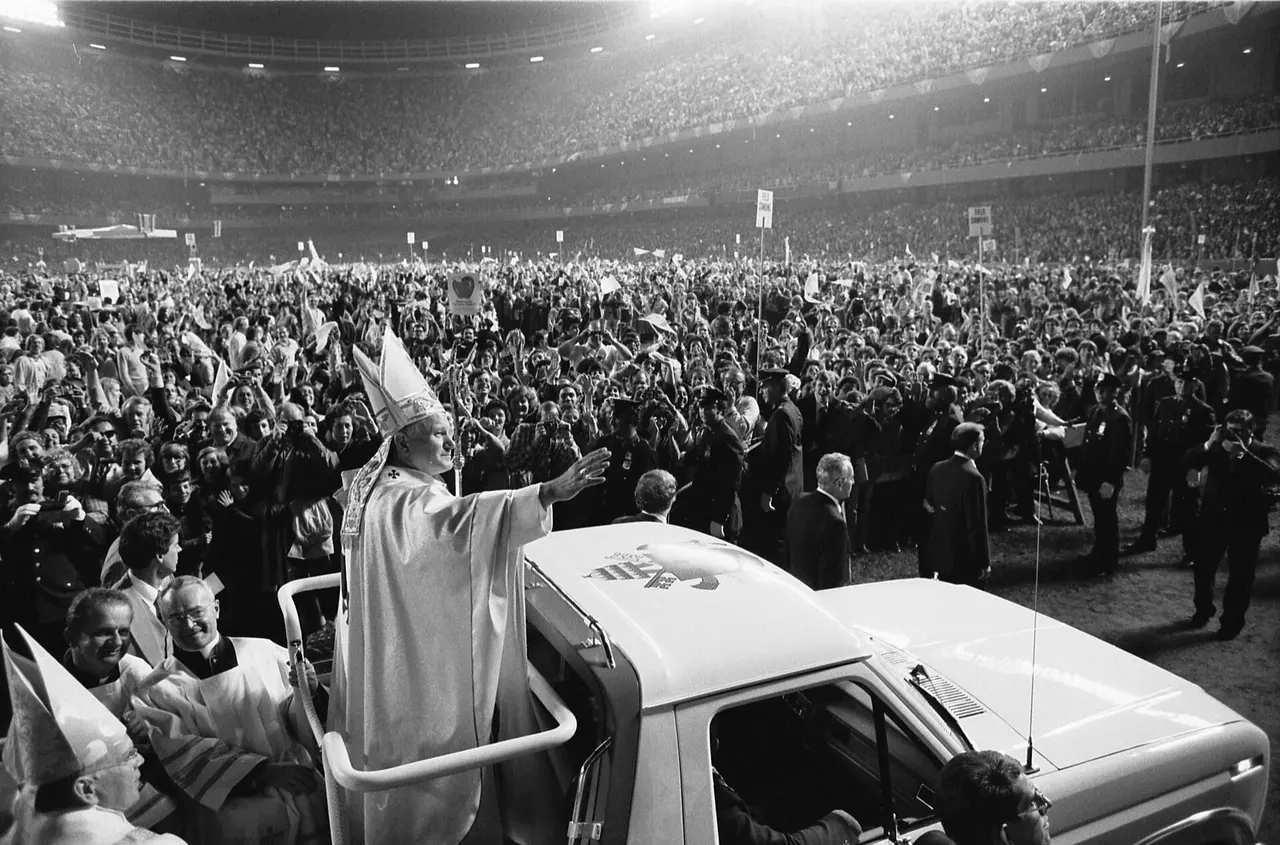
No pope before him had treated the whole world as a parish. Over 104 international journeys he visited 129 countries, kissing the ground on arrival - a ritual he said honored the people of each place and the Christ already present among them. He founded World Youth Day in 1985 and drew some of the largest crowds ever gathered, including an estimated four to five million in Manila in 1995. He was the first pope known to enter a synagogue and the first to enter a mosque, he prayed with leaders of other Christian churches and other religions, and on the Day of Pardon in March 2000 he publicly asked God's forgiveness for the sins committed by members of the Church across history.
He wrote fourteen encyclicals, the book-length Crossing the Threshold of Hope, poetry, and plays, and he canonized more saints than all his predecessors combined - insisting that holiness was not a museum category but the ordinary calling of every Christian.
His Teaching, in His Own Words
"Do not be afraid. Open wide the doors for Christ." From the homily at the Mass opening his pontificate, October 22, 1978. The line became the keynote of twenty-six years: Christ does not take anything true away from a human life, he completes it - so fear is the one thing faith cannot justify.
"Man is the primary and fundamental way for the Church." From his first encyclical, Redemptor Hominis (1979). The Church exists for the human person, not the reverse, and every question the Church takes up - politics, work, war, art - is finally a question about what a human being is.
"It is Jesus in fact that you seek when you dream of happiness; he is waiting for you when nothing else you find satisfies you." From his 1985 letter to the youth of the world, the founding document of World Youth Day. Restlessness, he told the young, is not a defect to medicate; it is a compass.
"Totus Tuus." His papal motto - "Totally yours" - taken from Saint Louis de Montfort's teaching on consecration to Mary. He said he chose it because everything he had, he had received through her hands, and everything he gave, he wanted to give through hers.
Watch: St. John Paul II
Video hosted on YouTube by the Vatican's own Vatican News channels and by EWTN. Each embed uses youtube-nocookie.com - no YouTube cookies are set unless you press play - and each video was verified playable before embedding.
John Paul II: Twenty Years Later - EWTN's documentary portrait of his life and legacy, twenty years after his death (27 minutes). Watch on YouTube.
His own voice: John Paul II addressing the indigenous peoples of Canada - a short clip that catches his warmth and his cadence better than any summary (under 4 minutes, Vatican News). Watch on YouTube.
These videos are hosted by their channels and were not produced by this site.
Frequently Asked Questions
Is John Paul II a saint?
Yes. Pope Francis canonized him on April 27, 2014, together with Pope John XXIII, before a crowd that filled Saint Peter's Square and the Via della Conciliazione. He is Saint John Paul II - not Blessed, and no longer Venerable; those were earlier steps on the way.
What miracles were recognized for him?
For beatification, the healing of a French nun, Sister Marie Simon-Pierre, from Parkinson's disease - the same illness he bore - after her community prayed for his intercession in 2005. For canonization, the healing of Floribeth Mora Díaz of Costa Rica from an incurable brain aneurysm in 2011, the day of his beatification Mass.
When is his feast day?
October 22 - not the day of his death but the anniversary of the Mass that opened his pontificate in 1978, when he first said "Do not be afraid."
Was he really shot?
Yes. On May 13, 1981 - the feast of Our Lady of Fatima - Mehmet Ali Ağca shot him at close range in Saint Peter's Square. He survived emergency surgery, publicly forgave Ağca within days, and visited him in Rome's Rebibbia prison in December 1983. One of the bullets was later set into the crown of the statue of Our Lady of Fatima in Portugal, at his wish.
Where is he buried?
In Saint Peter's Basilica. After his beatification his remains were moved from the Vatican grottoes up into the basilica itself, to the Chapel of Saint Sebastian, where pilgrims pray at his tomb today.
What was his relationship with Saint Charbel's tradition?
He canonized Saint Rafqa in 2001 and Saint Nimatullah al-Hardini in 2004 - the two Maronite saints closest to Saint Charbel - and in May 1997 he made the first papal visit to Lebanon, signing the post-synodal exhortation for the country at Harissa.
Sources
- Redemptor Hominis (1979), his first encyclical - the "man is the way of the Church" quotation
- Vatican News: the full canonization Mass of John XXIII and John Paul II (April 27, 2014) - the declaration, the date, the presider
- The Holy See: official biography of John Paul II - the life dates, Wadowice, the underground seminary, the 129 countries, and the 1981 assassination attempt
- Homily at the opening of his pontificate (October 22, 1978) - the "do not be afraid" quotation